
The Invisible Cost of Pausing Your SIP (It Is Not What You Think)
The months you skipped feel small. The compounding math says otherwise.

It was a reasonable decision at the time.
The market was falling. The news cycle was loud. Work was uncertain, or expensive, or both. You told yourself it was temporary. Four months, maybe five. Just until things settled.
And then things did settle. You restarted the SIP. You moved on.
What you did not do was calculate what those four months actually cost you. Not just the money you did not invest. The money that money would have made, compounded across the years that followed.
That number is almost always larger than people expect.
The Case Study: Two Investors, One Difference
Consider two investors. Same age, same fund, same monthly SIP of Rs 10,000. Both start in January 2015 with a 15-year horizon.
Investor A never pauses. Every month, without exception, the SIP runs.
Investor B pauses for four months during a market correction in year three. It feels insignificant. Four months out of 180. Less than 3% of the total investment period. She restarts in month five and stays consistent for the remaining twelve years.
At a 12% annualised return, Investor A ends with approximately Rs 49.9 lakh at the end of 15 years.
Investor B ends with approximately Rs 47.1 lakh.
The gap is Rs 2.8 lakh. From four paused months. On a Rs 10,000 SIP.
That is not the missed Rs 40,000 in contributions. That is what Rs 40,000, invested at the right point in the compounding curve, would have grown into over twelve years of uninterrupted growth.
Why the Math Hits Harder Than It Looks
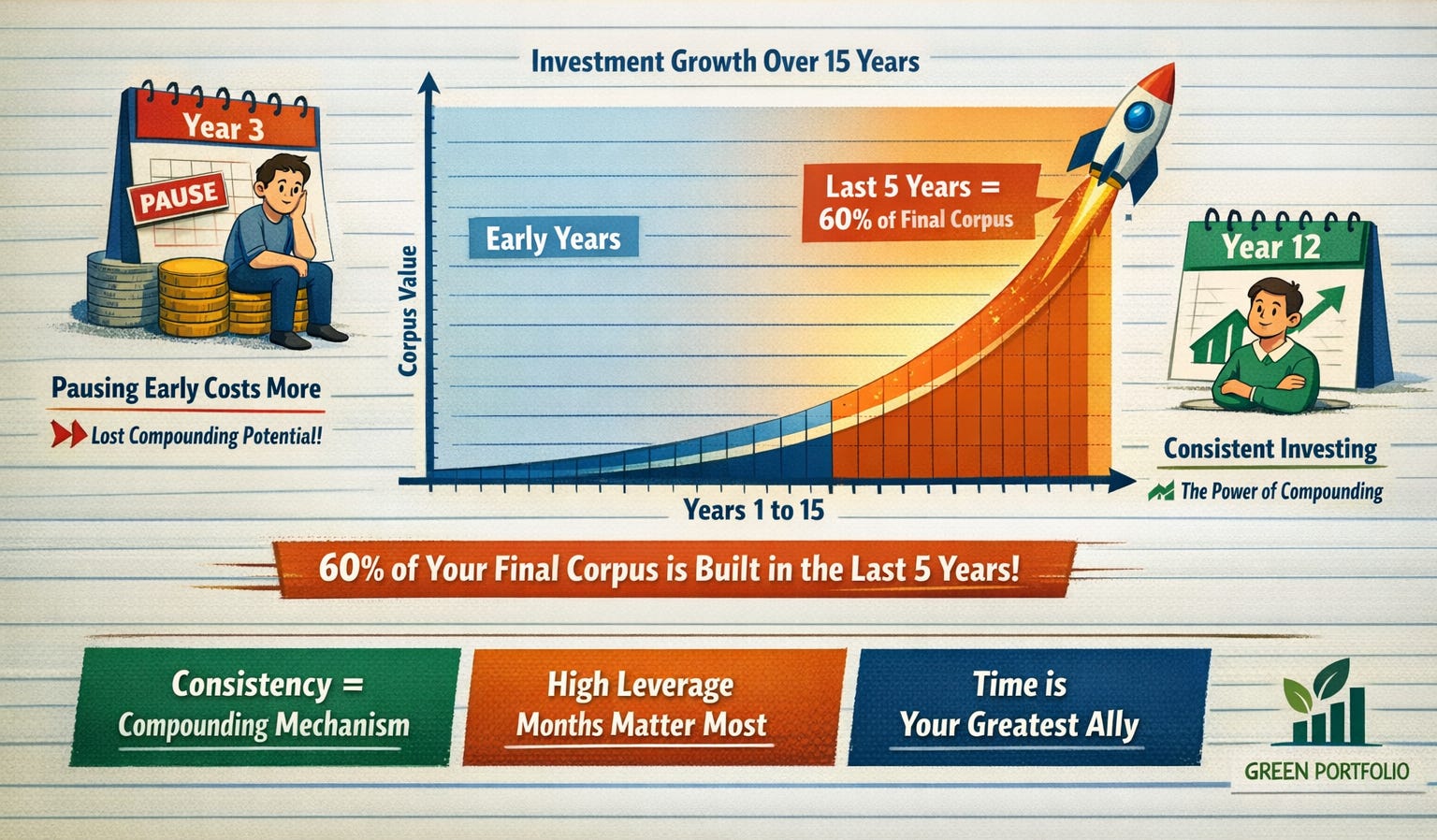
Compounding is not linear. The growth in the final years of a long investment horizon is disproportionately larger than the growth in the early years.
This is the part most investors understand intellectually but do not feel until they see the numbers.
In a 15-year SIP, roughly 60% of your final corpus is built in the last five years. Not because you invest more then, but because the earlier years of contribution have had the longest runway to grow. Every rupee invested in year three has twelve more years to compound. Every rupee you did not invest in year three had that same runway, and it went undeployed.
The four months you paused were not mid-journey months. They were high-leverage months. The cost of pausing in year three is structurally higher than pausing in year twelve, even though the SIP amount is identical.
At Green Portfolio, we call this one of the core principles inside the 6-Rule Discipline Protocol. Consistency is not a virtue in investing. It is a compounding mechanism. The investor who stays invested through the uncomfortable months is not being stubborn. They are protecting the leverage that time gives early contributions.
The Other Cost Nobody Calculates
There is a second cost to the pause that does not show up in any calculator.
When you pause during a market correction, you also miss the recovery.
Markets do not send a calendar invite when they bottom out. The four months you are on the side lines are often the months that do the most work. Missing the ten best trading days in a fifteen-year equity investment can reduce your final corpus by nearly 50%. Those ten days are almost never in a calm market. They are in the middle of the exact conditions that made you pause in the first place.
The pause feels like protection. The math says it is the opposite.
The Number
Missing just the 10 best market days in a 15-year SIP can cut your final corpus by nearly half. Those days almost always fall during periods of peak uncertainty, which are the same periods most investors choose to pause.
One Thing to Do This Week
Check your SIP history for the last three years and note any months where a payment was skipped or paused. Then ask yourself honestly: did you restart because the market improved, or because you had a plan that told you to? If it was the former, the next correction will produce the same pause.
A Note Before You Go

The investors who build real wealth are not the ones who timed the market well during corrections. They are the ones who had a structure that made pausing feel more expensive than staying in.
That structure is what The Wealth Roadmap is built around. A milestone that gives every SIP a destination. A portfolio built to hold through full market cycles. A rebalancing process that is triggered by rules, not by how the market feels on a Tuesday morning.
You do not need to be fearless during corrections. You just need a portfolio that gives you a reason to stay.
We are opening The Wealth Roadmap to the first 100 subscribers at 99% off the full subscription price.
Full access. The same process, the same research, the same fund selection framework that Green Portfolio applies to over Rs 1,000 Crore in AUM across 65,000 investors.
The 100 seats are not a marketing number. Several have already been claimed since the last edition. When they are gone, this price closes permanently. No waitlist. No second round. No exceptions.
If the math in this edition made you uncomfortable about your own SIP history, that discomfort is worth acting on: The Wealth Roadmap
More coming soon.
Disclaimer: Mutual fund investments are subject to market risks. Read all scheme-related documents carefully before investing. This newsletter is for educational and informational purposes only and does not constitute investment advice.