
Why India kept failing an exam it never took
Why "underperformance" was never the right word


Imagine preparing for months for a science examination. You study every chapter, solve countless practice papers and walk into the examination hall full of confidence. But when the invigilator hands you the question paper, you realize it is for Social Studies instead.
No matter how well you prepared, you were tested on something entirely different. The Indian stock market has found itself in a somewhat similar situation over the last few years.
The world suddenly shifted its attention towards Artificial Intelligence after the launch of ChatGPT in late 2022. AI became the biggest investment theme of the decade and the United States was best positioned to capitalize on it. Its technology giants had the capital, talent, computing infrastructure and research capabilities to lead this revolution. Investors naturally rewarded them, driving one of the strongest rallies in U.S. market history.
India, on the other hand, wasn’t built around the AI theme. We neither had global AI leaders nor large-scale semiconductor manufacturing or hyperscale data centre businesses that could directly benefit from this wave. As global capital chased AI opportunities in the U.S., Indian equities largely remained on the sidelines.
But there is one important thing investors must understand. The United States has always been the class topper of global financial markets.
It is home to the world’s largest equity market, with a market capitalization exceeding $60 trillion and accounting for nearly 45% of global stock market value. India, despite being one of the fastest-growing economies, represents only around 6% of the global market. To put the difference into perspective, the combined valuation of the Magnificent Seven companies alone is roughly 2.5 times the size of the entire Indian stock market.
When the world’s largest pool of capital moves, the rest of the world generally follows. That has been the norm.
However, the tide now appears to be shifting.
Over the last two weeks, the S&P 500 and Nasdaq have corrected by 7% and 3.4%, while India’s Nifty 50 and Nifty 500 have risen by 1.2% and 1.5%, respectively.
At first glance, a few percentage points may not seem particularly noteworthy. Yet these small divergences often signal the beginning of a much larger shift in investor sentiment. Sometimes, the biggest stories begin with the smallest cracks
Why is the US Market Correcting?

The U.S. stock market is coming off one of the strongest bull markets in its history. Since the beginning of 2023, the S&P 500 and Nasdaq have delivered CAGR returns of approximately 24% and 35%, respectively, as of the end of July 2026. These are extraordinary returns for markets of such enormous size. Many investors would be delighted to earn these returns from a handful of carefully selected small-cap stocks. Yet these gains came from the broader indices themselves.
The rally was fueled by one transformational event.

In November 2022, OpenAI launched ChatGPT, triggering the global race for Artificial Intelligence. Almost overnight, AI became the dominant investment theme. Technology giants such as Nvidia, Microsoft, Alphabet, Amazon, Oracle and Meta committed hundreds of billions of dollars towards AI infrastructure. At the same time, companies like Anthropic, Palantir and CoreWeave emerged as major beneficiaries of this technological shift.
Building AI, however, is enormously capital-intensive. It demands advanced semiconductor chips, massive computing clusters, data centres, power infrastructure, clean water and thousands of highly skilled engineers. As investments surged, so did stock prices. In fact, AI-related companies accounted for nearly 75% of the gains during this historic rally.
Today, however, investors are beginning to ask a different question.
While AI adoption continues to accelerate globally, the commercial monetization has not yet kept pace with the enormous capital being deployed. Companies that were once cash-flow machines are now committing unprecedented levels of capital expenditure, compressing free cash flows and testing investor patience. As expectations become more realistic, valuations are normalizing.
Many of the biggest AI beneficiaries, including Sandisk, Micron, Marvell, Intel and several semiconductor stocks, have corrected sharply from their peaks by 45%, 28%, 42% and 35%, respectively.
This doesn’t imply that AI has failed. Far from it. AI remains one of the most transformative technologies of our generation. The market is simply transitioning from unrestricted optimism to disciplined optimism, where earnings and cash flows once again matter more than narratives.
India’s Theme is Not AI
Unlike the U.S., India has very limited direct exposure to the AI investment cycle. Whether it is large language models, advanced semiconductor manufacturing or hyperscale AI infrastructure, India’s participation remains relatively small compared to developed economies.
Ironically, this became one of the reasons Indian equities underperformed over the past two years. As global investors chased AI opportunities, a large share of international capital flowed into U.S. technology companies, leaving emerging markets relatively overlooked.
Yet this may now be turning into India’s biggest advantage. India’s investment story has never depended on AI. It has always been built on two powerful structural themes: Consumption and Manufacturing.
1> Consumption

India possesses one of the largest addressable consumer markets in the world. A population of over 1.4 billion people, rising urbanization, increasing formal employment and a rapidly expanding middle class continue to create enormous long-term demand across industries.
More importantly, the quality of consumption is improving.
As GDP per capita steadily rises, Indian households are spending more on discretionary and premium products rather than only essential goods. Premium smartphones, branded apparel, organized retail, automobiles, travel, healthcare and financial products are witnessing stronger demand than ever before.
This gradual premiumization of consumption is creating long growth runways for companies serving the domestic market. Unlike cyclical investment themes, consumption compounds over decades.
2> Manufacturing
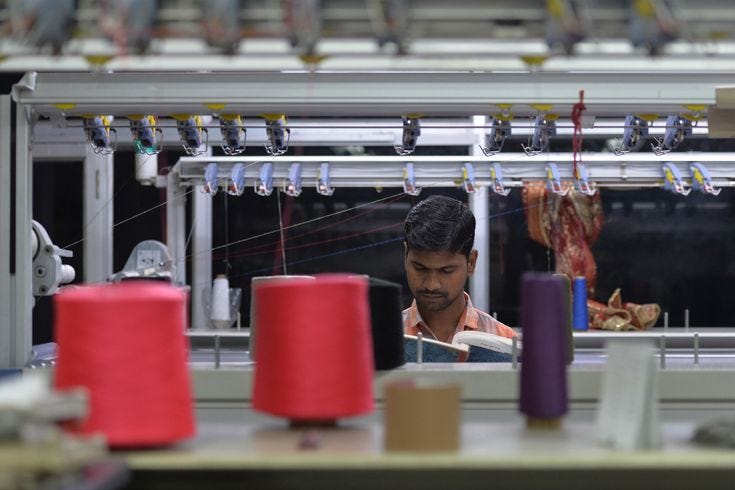
India’s second major strength is its cost advantage. The country offers significantly lower production costs than most developed economies due to abundant resources, competitive labour costs and a large pool of educated talent. This has positioned India as an increasingly attractive manufacturing destination, not only for domestic demand but also for global exports.
The momentum is visible across several sectors, including defence, electronics manufacturing services (EMS), pharmaceuticals, textiles, chemicals and industrial manufacturing. Both government and private-sector capital expenditure remain strong as companies continue expanding production capacities to capture this opportunity.
India’s recent Free Trade Agreements with countries such as the United Kingdom, New Zealand, and ongoing negotiations with the European Union further strengthen this manufacturing story by improving export competitiveness and expanding market access for Indian businesses.
The Way Ahead
India may have largely missed the AI investment boom. But that does not make it a less attractive investment destination. The U.S. is currently navigating the challenges of sustaining an AI-led investment cycle after an extraordinary rally. India, meanwhile, is benefiting from structural drivers that are still in the early stages of their growth journey.
Consumption is expanding. Manufacturing is accelerating. Public and private capex remain robust. Government policies continue to support industrialization, exports and infrastructure development.
Markets rarely move in a straight line, and leadership often changes with time. The recent divergence between the U.S. and Indian markets may well be the first indication that global investment capital is beginning to recognize India’s own structural strengths rather than viewing it merely as an extension of global risk sentiment.
The tide, perhaps, is finally beginning to shift.
Green Portfolio’s Stance
At Green Portfolio, our investment philosophy has always been rooted in India’s structural growth story.
Long before manufacturing and domestic consumption became mainstream investment themes, our portfolios were built around businesses that stood to benefit from these long-term trends. Today, our allocations remain concentrated in sectors such as chemicals, capital goods, auto ancillaries, energy and infrastructure, all of which are direct beneficiaries of India’s expanding manufacturing base and rising domestic consumption.
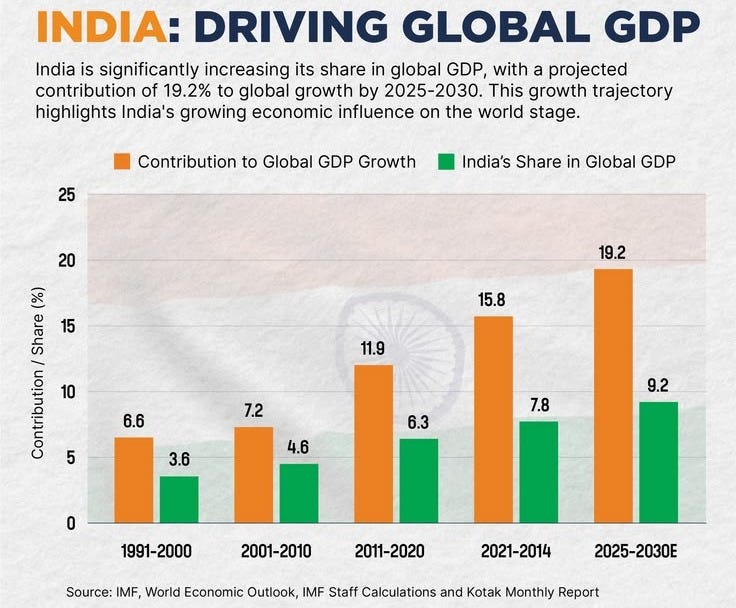
Our belief is simple. India is home to several high-quality small-cap manufacturing businesses that have the potential to become industry leaders over the next decade. While these companies may be relatively unknown today, many possess strong competitive advantages, capable management teams and long growth runways that can create significant shareholder value over time.
This philosophy has served our investors well in the past through our early investments in companies such as Force Motors, Sejal Glass, and OBSC Perfection, where identifying structural opportunities ahead of the broader market translated into meaningful wealth creation.
That pursuit continues every single day. We remain committed to identifying fundamentally strong businesses that can compound earnings over the long term and generate substantial value for our investors. The recent market environment has once again created attractive opportunities across India’s manufacturing ecosystem, reinforcing our conviction that this structural theme is still in its early innings.
While market leadership may shift across countries and sectors over time, our focus remains unchanged, partnering with exceptional Indian businesses that can grow alongside the country’s next phase of economic development.
Disclaimer: This newsletter is for informational and educational purposes only and does not constitute investment advice or an offer or solicitation to buy or sell any securities, including in any public issue. Views expressed are based on publicly available information as of the date of publication and may change without notice. Please consult a qualified financial adviser before making any investment decision.