

About 500 million vehicles ply Indian roads. Cars, buses, trucks, three-wheelers, tractors, and even construction equipment. Irrespective of age or make, they all need an irreplaceable component that has changed little over decades: tyres.
From your grandfather’s Maruti 800 to the latest EV, most tyres fall within a standardised set of sizes, with most garages stocking from the easiest-accessible manufacturer. After fuel, tyre health remains consistently critical, irrespective of vehicle type.
The business model reality: replacement demand + distribution moat.
The business model reality: replacement demand + distribution moat
To a layman, buying a vehicle means servicing it regularly and replacing components only when needed. But tyres are different: most must be replaced within five years or earlier, depending on usage. India’s notoriously bad road conditions accelerate this cycle.
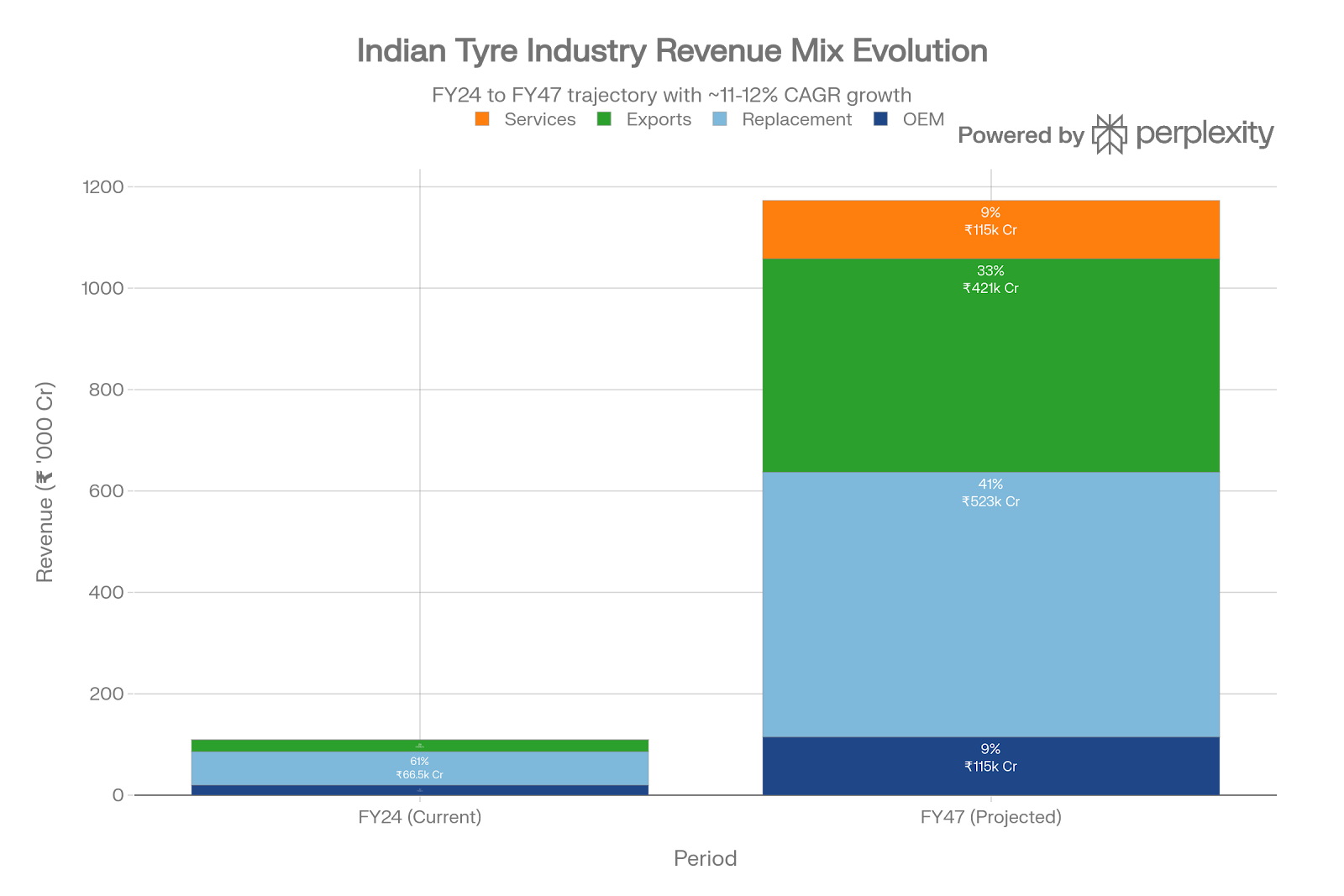
For Indian tyre manufacturers, replacement demand is the main revenue source: almost 61% of tyre demand comes from replacements, while OEMs constitute just 18% of revenues in FY24-25.
JK Tyre, CEAT, MRF, and Apollo (the market leaders) focus on capturing this replacement demand, which represents more than 60% of the total tyre market in India.
For these companies, the path to dominance lies in two things:
Distribution reach: Ensuring their products are available across the country, from metros to Tier-III towns.
Cost discipline: Keeping manufacturing and logistics costs in check to protect margins.
This remains a constant challenge, with revenues directly correlating to operational strategy and input cost management.
What changed in 2025: GST, rubber, crude, operating leverage
For tyre companies, 2025 has been a good year. Lower input costs boosted margins, and three specific tailwinds converged:
Natural rubber prices declined
Natural rubber constitutes about 44% of manufacturing costs. From a peak of $2.21 per kg in September 2024, prices declined to $1.66 per kg by late 2025, as leading global manufacturers reduced pre-buying due to US tariff uncertainties.
Crude oil prices dropped
Crude oil prices fell below $60 a barrel in May 2025, reducing oil-derived input costs, which represent another 25 to 35% of tyre production costs.
GST rate cut unlocked demand
In September 2025, the GST rate on pneumatic tyres was reduced from 28% to 18%. Tyres became suddenly cheaper, boosting replacement demand even as manufacturers expanded margins.
Together, these factors created operating leverage: lower input costs plus stable or rising volumes equals record margins.
Why rural India matters more than you think
For a monsoon-dependent country, 2025 has been kind. According to the IMD, India’s monsoon was above average, boosting disposable incomes with highly successful rabi and kharif harvests.
Higher rural cash flows encouraged consumption, boosting tractor utilisation and two-wheeler usage. This cascaded into vehicle purchases and, eventually, tyre sales for both passenger and agricultural segments.
For tyre companies, this meant stronger demand. The two-wheeler tyre market grew by almost 20% in FY25, according to research firm ACG.
During the festive October to December 2025 season, CEAT and JK Tyre reported double-digit growth, while other companies ramped up production to meet demand.
For all tyre companies, Q3 FY25-26 has been one of the best quarters witnessed so far, as strong rural demand for replacement tyres and surging vehicle sales drove record profits across the sector.
ACG.
What can go wrong in 2026
Behind the euphoria comes a brutal truth: tyre companies cannot control commodity prices or demand shocks. They can only navigate them. Several risks loom for 2026:
Commodity price volatility
Global warming, declining production, or rising demand could push natural rubber prices back up. Geopolitical risks (like the US tariff threat) add uncertainty. Tyre companies would have no option but to pass costs to customers, risking volume loss.
Pricing power limits
Price hikes could affect market share, especially if disruptions in commodity availability hit some players harder than others. Differential access to rubber or crude derivatives could shift competitive dynamics.
Price wars
If commodity prices remain subdued for long, ramped-up inventories in certain segments could trigger a price war. This would be a lose-lose situation for all players, compressing margins without gaining lasting share.
Revenue mix risks
If OEM demand slows while replacement demand stays firm, companies will have to lean harder on exports to meet targets. Export markets are more competitive, with pressure from cheaper sources like China, Vietnam, and Indonesia.
What to watch next quarter
Input cost trends
Weather will play a part, as will geopolitical risks that directly affect oil-linked input costs. Watch for natural rubber price commentary in earnings calls.
Export growth and realisations
With limited domestic capacity for growth, how will the main players expand beyond India? Global competition from cheaper sources like China, Vietnam, and Indonesia will test pricing power and brand positioning.
Replacement market share
How will domestic tyre companies protect their share, given capacity constraints and the expanding presence of competitors? Watch for commentary on distribution reach, dealer incentives, and brand spend.
Operating leverage sustainability
Q3 FY26 margins benefited from a perfect storm: lower input costs, GST cut, and strong rural demand. Can companies sustain margins if one or two of these tailwinds reverse in Q4 or FY27?
OEM vs replacement mix
If OEM demand picks up (due to auto sector recovery), will companies shift focus back, or will they maintain replacement-first strategy? This reveals long-term positioning.
Disclaimer: This newsletter is for informational and educational purposes only and does not constitute investment advice or an offer/solicitation to buy or sell any securities. Views expressed are based on publicly available information as on the date of publication and may change without notice. If any past performance or return figures are mentioned, they are for context only, past performance may or may not be sustained in the future. Please consult a qualified financial adviser before making any investment decision.