
The Rupee Is Falling. The RBI is fine. You can still be affected
We may hear about it, but may not bother about it much. Yet, the falling Rupee affects us in more ways than we think.

The Rupee has quietly weakened to ₹93 to a dollar. In 2011, it was ₹45. That is a 48% depreciation over 15 years, even as the economy grew five times over. And yet, for most Indian households, it has barely registered. No single moment of shock, no obvious change in daily life. That is exactly what makes it worth understanding. Because the rupee’s slide is not invisible. It is showing up in your EMI timeline, your grocery bill, your travel budget, and your investment portfolio. You just have not been told where to look.
What is Actually Happening Right Now (Without you noticing)
The Rupee has depreciated to around ₹93 against the dollar in March 2026. This comes at a time when the Middle East war led oil import disruption has strengthened the dollar globally, making imports dearer for all.
But for India, this hasn’t been a one-off situation- the Dollar has strengthened almost 9% in the last one year. Throughout 2025, FIIs have been liquidating their domestic investments, directly impacting the steady decline in the Rupees strength against the dollar.
Though this has been going on for quite some time now, the RBI hasn’t been too concerned, with just a few interventions aimed to stabilizing the Rupee to arrest volatility.
Even though almost 86% of our imports are invoiced in dollars, India’s forex reserves remain adequate enough to arrest any extreme price shocks, a meaningful buffer that protects you from unrestrained price rise.
India’s forex reserves have been our most handy tool, strengthened by consistent inflow of remittances from abroad- that gives us about $709 billion, about the size of the entire economies of Ireland or Sweden.
Currently, the Rupee has depreciated beyond the ₹90 mark, crossing the sentimental mark that the government would generally defend more aggressively. Given the current scenario in West Asia, the RBI hasn’t announced any further interventions to defend the Rupee’s value.This signals the RBI’s wait and watch policy that could change once further clarity is achieved.
Why the RBI May Be Fine With This
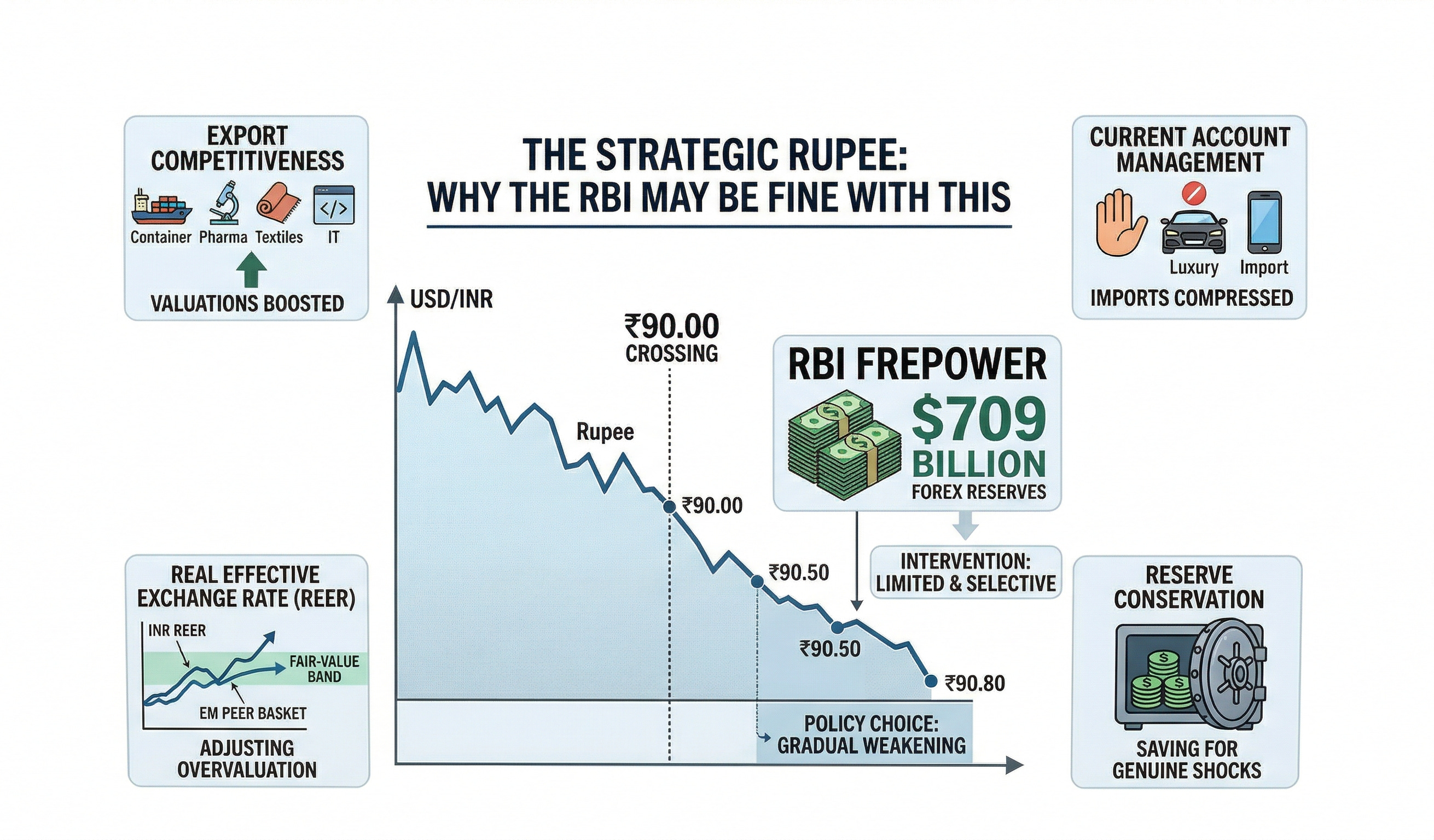
The rupee crossing ₹90 is not a failure of policy. It may be the policy. The RBI has the firepower to defend the rupee more aggressively — it has $709 billion in forex reserves to prove it. The fact that it has chosen not to is a signal worth reading carefully. A gradually weaker rupee serves several objectives at once, and the RBI knows it.
Export competitiveness: A weaker rupee makes Indian goods cheaper in dollar terms. With global trade disruption creating new sourcing opportunities for India (China+1, supply chain shifts), the timing of a slightly weaker rupee offers textiles, pharma, engineering goods, and IT exporters an opportunity to get richer valuations.
Current account management: A weaker rupee discourages unnecessary imports, helping compress the current account deficit without requiring direct import restrictions.
Real effective exchange rate: India’s REER (Real Effective Exchange Rate) that measures the Rupee’s performance against a basket of global currencies, adjusted for inflation, has historically been overvalued. If the nominal depreciation is lower than its peers this could be a positive sign, even as the nominal exchange rate stays the same.
Dollar reserve conservation: By allowing gradual depreciation instead of aggressive defence, the RBI preserves reserves for when they are genuinely needed — a large sudden shock, not a slow grind
Over the years, the RBI has been keeping a watch on the Rupee, while ensuring it has control over the market in uncertain conditions like this. For now, the primary objective is within reach, allowing the RBI room to fight the right battles.
How could this affect you?
Though you may not immediately notice it, a weaker Rupee affects your expenses and budgets in more ways than you think.
The EMI Connection
When the Rupee rises, so do your EMIs, eventually. When the Rupee weakens, it takes more to buy the same barrel of oil, immediately rising transportation costs, resulting in higher prices for everything from vegetables to online deliveries.
This inflation forces the RBI to increase the Repo rate ( at which it lends to banks), eventually passing on this cost to your home, car or personal loan EMI. This could mean longer loan tenures, with each 25 basis points (bps) rate cuts increasing the EMIs by about ₹1200-1500 per month for a Rs. 50 lakh loan.
Higher travel, education costs

If your son is studying abroad, the devalued Rupee could mean shelling out more for the same amount of dollars. A $50,000 loan sanctioned at ₹83 will now require about ₹5 lakh more to repay for the same amount of dollars.s
If you’re just getting ready to go abroad, this could mean additional costs for the same trip, scuttling your budget.
The inflation tax
There are certain invisible taxes attributed to the rising rupee as well. India currently imports most of its edible oils, electronic components and fertilizers, all of which become expensive with a weaker rupee. Some companies or government PSUs eat the losses, but not always. This eventually results in sustained inflation over a longer period, with your grocery bill, your gadget upgrade or your kitchen appliance cost rising over 6-12 months.
Who gets hurt the most, who benefits the most
Though inflation and rising demand naturally devalue the Rupee, global geopolitical tensions can accelerate these challenges, which can hurt some, while benefitting others.
Those who benefit:
IT exporters (TCS, Infosys, Wipro, HCL): every 1% rupee depreciation adds approximately 40–50 bps to operating margins, before hedging
Pharma exporters: similar dollar-revenue, rupee-cost structure
Textile and leather exporters: direct price competitiveness gain
Engineering goods exporters with dollar contracts.
Those who lose:
Oil marketing companies (IOCL, BPCL, HPCL): import crude in dollars, sell in regulated rupee prices — margin squeeze unless prices are raised
Aviation (IndiGo, Air India): dollar-denominated aircraft leases and fuel
Corporates with unhedged dollar debt
Import-dependent manufacturers: electronics assembly, specialty chemicals
What to Watch
Even though the West Asian war shows no sign of slowing, other factors could affect the Rupee’s trajectory in the near future.
If India’s Consumer Price Index (CPI) stays above 4.5%, there could be lesser room for the Rupee to strengthen, dimming hopes for cheaper EMIs.
FIIs pulled out a record ₹1.58 lakh crore (approximately $18 billion) from Indian equities across the full calendar year 2025, the largest annual exit ever recorded, surpassing even the previous record of ₹1.21 lakh crore set in 2022.
If the US Dollar Index (DXY) softens, this could stablise the Rupee further, without the RBI needing to make any further interventions.
Even after the war, if crude stabilizes below $95, this could help tilt the scales in the Rupee’s favour.
The crisis that has to be managed
The rupee at ₹93 is not a rupee in crisis. It is a rupee being managed through a difficult global moment by a central bank that is picking its battles carefully. The panic in the headlines is overdone. But the consequences on your EMI timeline, your import bill, your travel costs, your portfolio’s sector exposure are real and worth tracking. The difference between an investor who understands this and one who does not is not whether they worry about the rupee. It is whether they know which rupee story to actually worry about.
Disclaimer: This newsletter is for informational and educational purposes only and does not constitute investment advice or an offer or solicitation to buy or sell any securities. Views expressed are based on publicly available information as of the date of publication and may change without notice. Please consult a qualified financial adviser before making any investment decision.