
The quarter that "should" have broken India Inc.
India Inc.'s Q1 Report Card


The stock market is always chaotic. Whether it is geopolitical tensions, rising inflation, volatile investments, or a global health crisis, investors feel everything directly or indirectly through the ebbs and flows of the market.
No matter what, an investor can always count on the chaos of the market. This volatility tends to increase further during the results season, and this quarter was especially difficult to navigate. The West Asia crisis involving the US, Israel, and Iran threw even the slightest sense of certainty out of the window. The conflict began in March 2026, just as we were entering a new financial year, and its ripple effects were felt across the economy.
First and foremost, crude oil became the first casualty. Until February 2026, crude was trading comfortably below $70 per barrel with relatively little volatility. Once the conflict began, however, crude prices breached the $110 per barrel mark, an increase of more than 40% within a single month. While prices have since eased, crude continues to trade at elevated levels of around $80–90 per barrel.
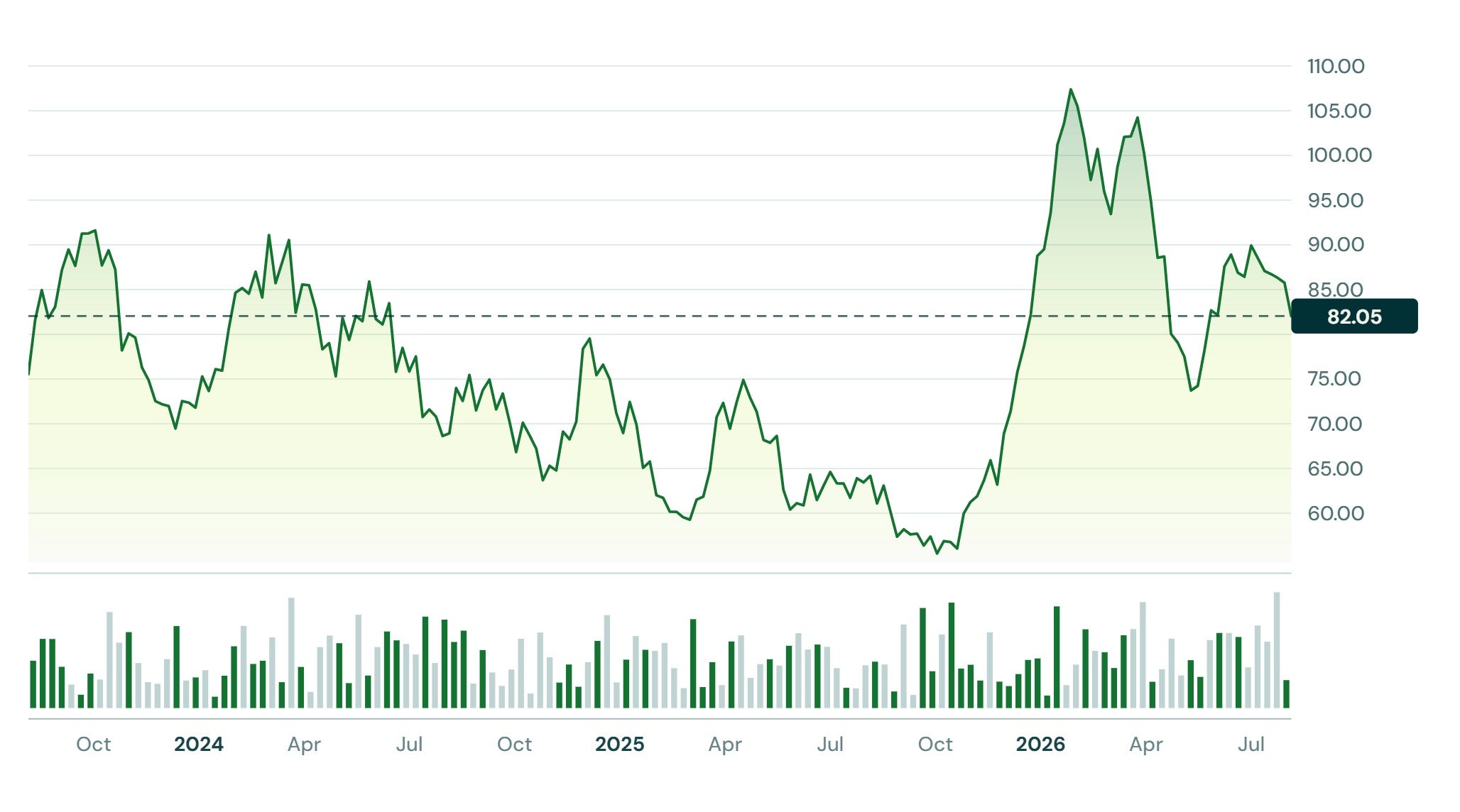
The problem was not limited to higher crude prices. The cost of almost every essential commodity increased. Oil is a critical input for processing raw materials, mining and transportation, which means that higher energy costs are quickly filtered through the entire supply chain. This was not an easy shock for the economy to absorb.
Inflation was expected to rise, household expenditure was expected to weaken, corporate capex was expected to slow, and manufacturing activity was expected to come under pressure. Hence, it came as no surprise when the RBI lowered its FY27 GDP growth projection from 6.9% to 6.6%.
India Inc.’s back was against the wall, and expectations for the economy were far from flattering.
Yet, India has come out swinging.
Surprising Q1 FY27 Results
The Q1 FY27 results have delivered a surprise that few investors were expecting. There are 5,139 actively traded stocks in the Indian market, of which more than 3,000 companies have announced their results so far.
The numbers are speaking for themselves.
1,916 companies have reported YoY growth in both revenue and net profit, compared with 1,370 companies that have reported a decline in both.
At an aggregate level, companies have delivered YoY revenue growth of 18.9% and net profit growth of 9.9%.
These numbers matter because this is exactly what fundamentally driven, long-term investors had been waiting for ever since the correction in the Indian market. The market correction had brought valuations down, but the bigger question was always whether corporate earnings could hold up against a challenging macroeconomic environment. Q1 results are providing an encouraging early answer.
But it is important to study the details, because that is where the story gets interesting.
Companies are absorbing the shock, not surrendering to it
The first thing that stands out is the gap between revenue and profit growth. Revenue has grown significantly faster than profits, 18.9% versus 9.9%.
At first glance, this may appear negative. But in the current environment, it could actually be a sign of resilience.
Indian companies are absorbing a meaningful portion of the cost pressures rather than simply passing them on to consumers or cutting back on growth investments. Higher input costs, logistics expenses and other inflationary pressures are being reflected in margins, which explains why profit growth has lagged revenue growth.
More importantly, companies have not taken their foot off the growth pedal. Capex has continued. Expansion plans have continued. Capacity additions have continued. Companies are willing to accept some short-term pressure on profitability in exchange for building capacity and capturing the long-term opportunity.
That is a positive sign for the economy.
It suggests that corporate India is not responding to temporary uncertainty by becoming defensive. Instead, many businesses are willing to endure short-term pain to secure long-term growth. For a long-term investor, that is exactly the kind of behaviour worth watching.
Manufacturing is leading the way
The second major takeaway is where the growth is coming from. India’s manufacturing economy has continued to surprise on the upside. Several manufacturing-led sectors, including textiles, chemicals, capital goods, defence, shipbuilding, mining and metals, have reported double-digit YoY growth.
This is important because India’s next leg of economic growth is increasingly being driven by the country’s transition from a consumption-led economy to one that is also becoming a meaningful manufacturing and export hub.
The investment cycle remained a key positive during the quarter, with central government capital expenditure rising 24 per cent year-on-year to ₹3.4 lakh crore in Q1. The spending accounted for 28 per cent of the full-year budgeted target and was focused on railways, defence and capital transfers to states. New project announcements reached a multi-quarter high, driven by sectors including data centres, electronics manufacturing and nuclear power.
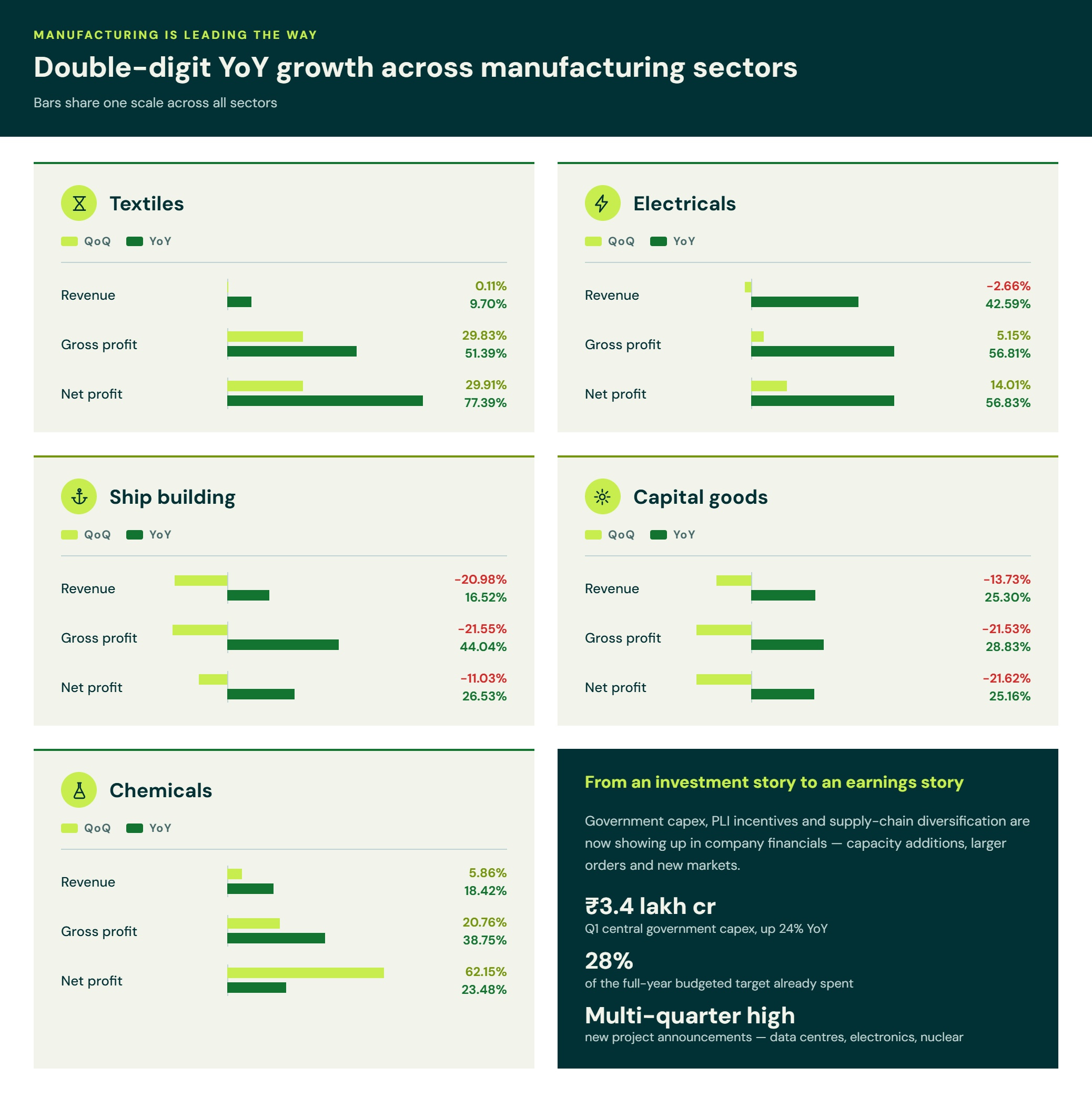
The investments made over the last few years, whether through government incentives, infrastructure spending, private-sector capex or supply-chain diversification, are beginning to show up in corporate financial statements.
The result is visible in the numbers. Companies are adding capacity, winning larger orders, expanding into new markets and increasing their production capabilities. What was once an investment story is gradually becoming an earnings story.
And that transition is arguably more important than the headline GDP number.
Consumption is holding up too
The strength has not been limited to manufacturing.
Despite elevated inflation and higher commodity prices, consumption has remained surprisingly resilient. Gold and jewellery, hospitality and FMCG companies have all reported strong volumes, with several businesses delivering record levels of sales.
This is particularly encouraging because consumption is often the first area investors expect to weaken when inflation rises. Higher household expenses typically leave consumers with less disposable income, creating pressure on discretionary spending.
Yet, the Q1 numbers suggest that Indian consumers are still spending.
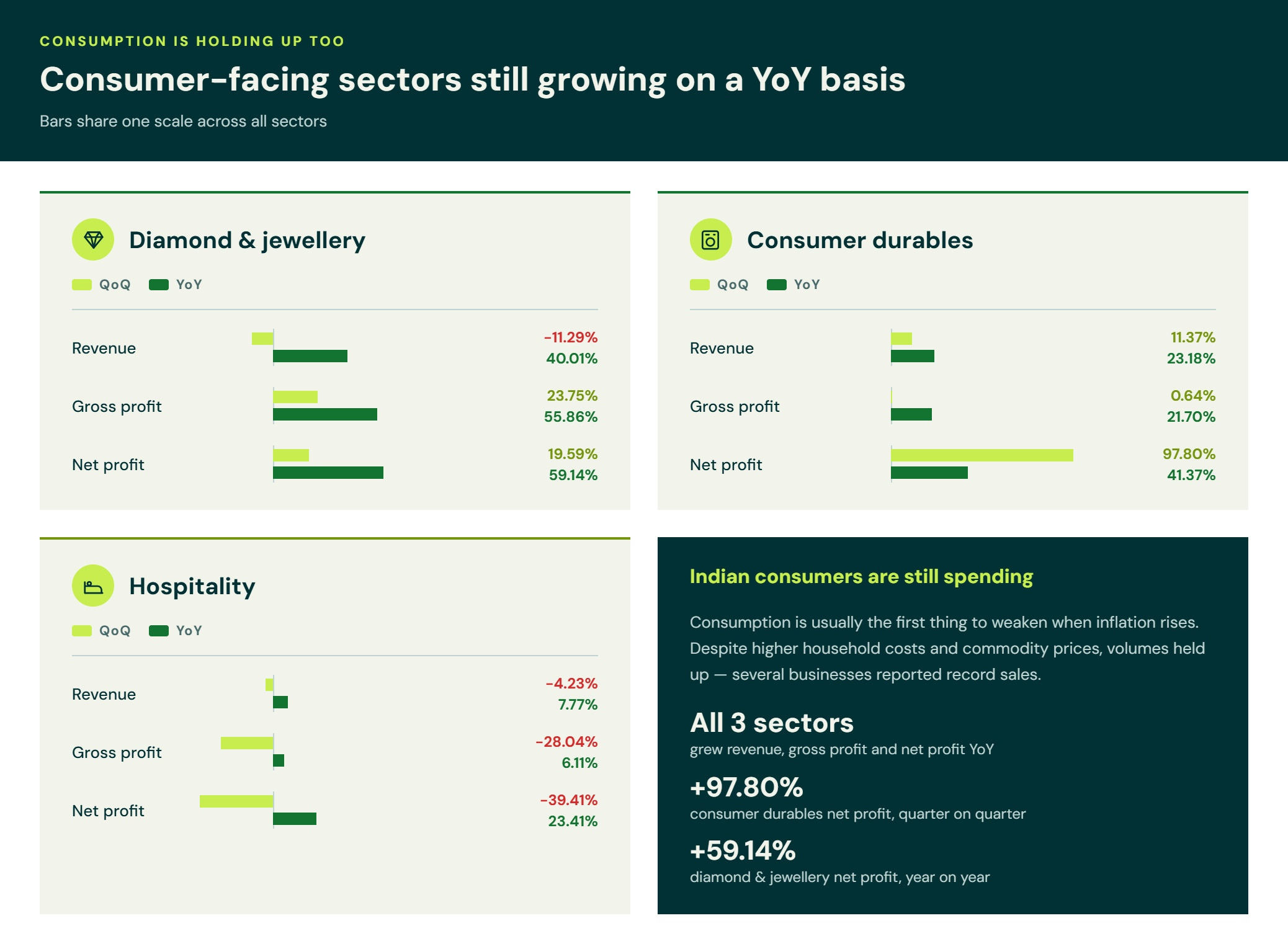
This creates an interesting combination for the Indian economy: manufacturing is expanding while consumption remains resilient. That combination is precisely what a fundamentally strong economy needs.
The Q1 FY27 results therefore tell a story that is more nuanced than simply looking at aggregate earnings growth. Companies are facing higher costs, but they are continuing to invest. Margins are under pressure, but revenues are growing strongly. Manufacturing is accelerating, while consumption remains resilient.
The market may continue to be volatile. Geopolitical risks will not disappear overnight, and commodity prices can remain unpredictable. But beneath that volatility, the underlying corporate economy appears to be holding up far better than expected. And for long-term investors, that may be the most important signal of all.
Green Portfolio Take
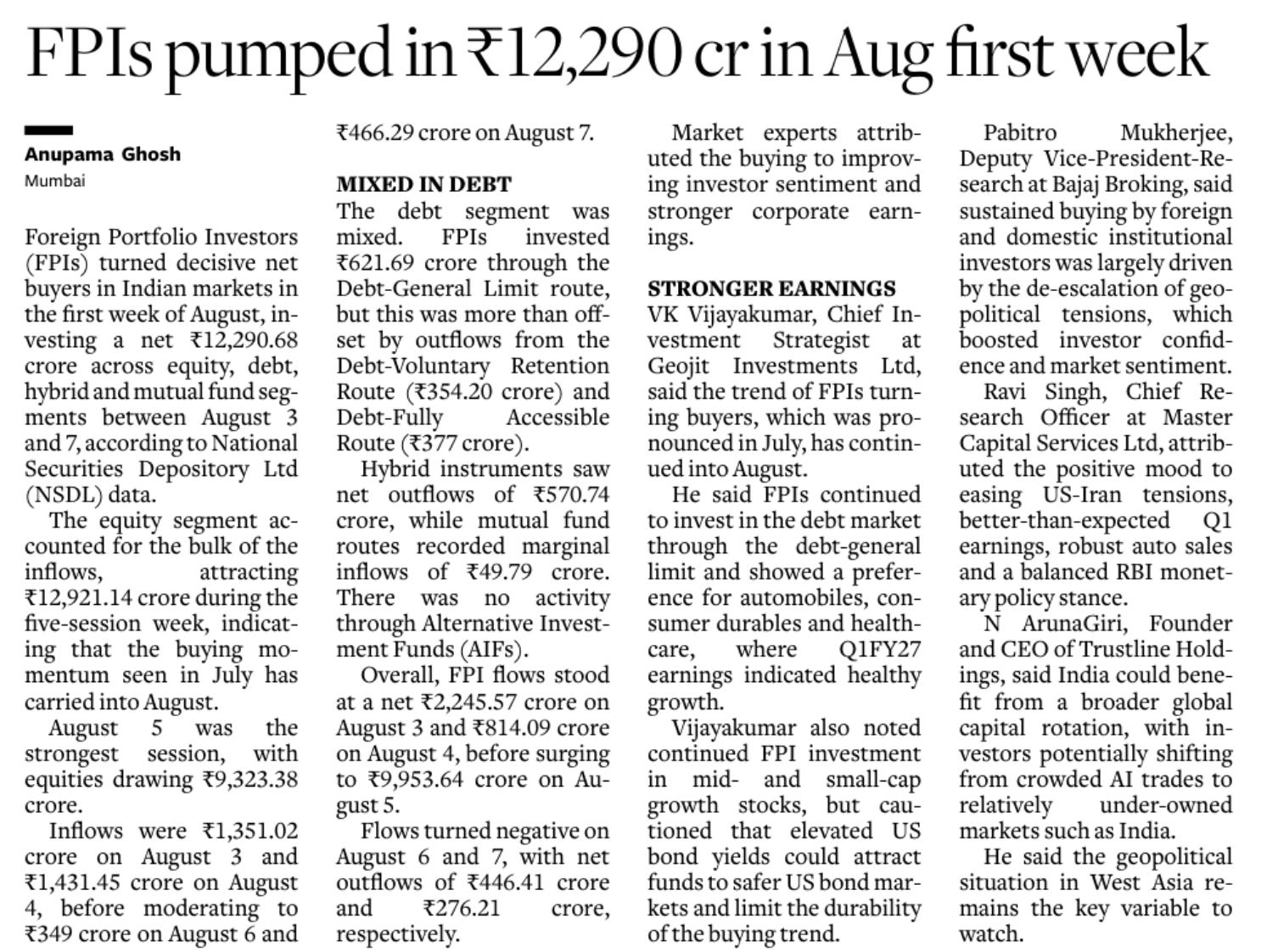
For anyone associated with our fund or following our newsletter, our thesis by now should be clear: we remain highly bullish on the Indian market. This conviction does not come from bias or blind optimism; it stems from the massive opportunity that the Indian economy presents and the resilience that India Inc. has consistently demonstrated.
For any investment to work, three things need to come together: the market must offer an attractive opportunity, the company must have a credible growth strategy, and the valuation must leave enough room for returns. We constantly strive to find this combination because it is the amalgamation of these factors that creates the magic for investors.
The last two years have presented Indian markets with no shortage of challenges, all of which are well documented. You will find countless articles highlighting them. But we are sincere students of the market, patiently studying businesses and waiting for the right opportunities while others lose patience.
Mr. Market is chaotic, unpredictable and often irrational, but he is also fair to those willing to withstand his tantrums. Fortunately for us, we have gotten used to them.
Disclaimer: This newsletter is for informational and educational purposes only and does not constitute investment advice or an offer or solicitation to buy or sell any securities. Views expressed are based on publicly available information as of the date of publication and may change without notice. Please consult a qualified financial adviser before making any investment decision.