
The magic pill just went generic. Here's your portfolio's position.
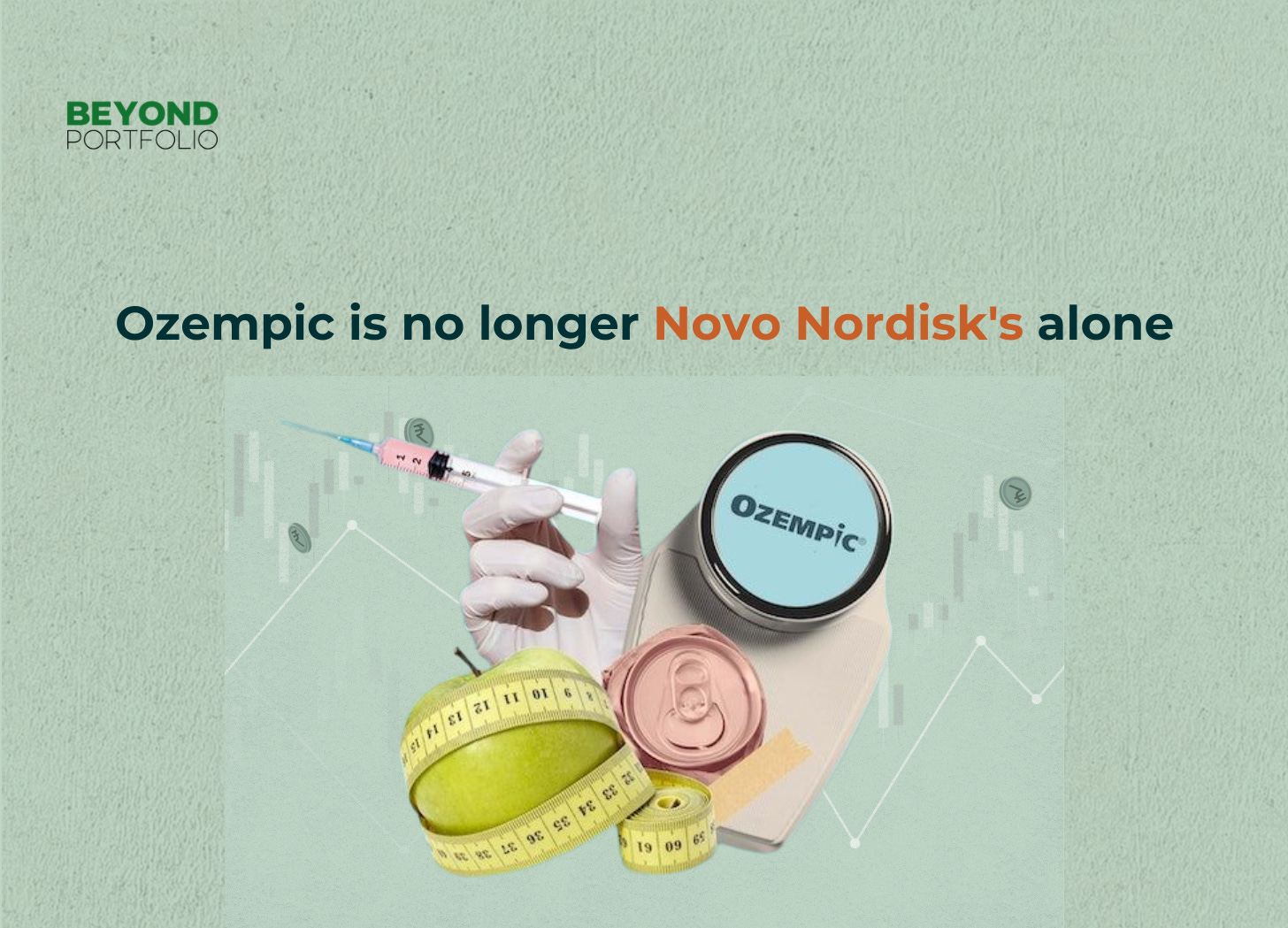
Ozempic is no longer Novo Nordisk's alone.

We want to talk about something that’s been all over the internet for the last two years, but that most people haven’t yet looked at from an investor’s lens.
You’ve seen Ozempic everywhere. On your Instagram feed, in celebrity interviews, in conversations at weddings and gyms and office cafeterias. It became one of those rare drugs that crossed over from clinical vocabulary into everyday language. People started referring to dramatic weight loss as “the Ozempic effect.” Influencers documented their journeys publicly. Demand built itself without any pharmaceutical marketing, which is genuinely extraordinary for a prescription drug.
What just changed is that the molecule behind all of this, Semaglutide, has gone off-patent in India.

Novo Nordisk’s monopoly on Ozempic is over, at least in India. Any Indian generic manufacturer can now produce, sell, and distribute their own version of the drug. Ten companies already have. And the market that’s about to be unlocked is, by any measure, enormous.
Nomura estimates the Indian semaglutide market will reach Rs. 12,000 crore within five years. That’s a CAGR of over 30% between FY26 and FY30. To understand why that number is credible, consider the addressable base: India has over 100 million diabetic patients and over 250 million people affected by obesity. Both conditions are chronically undermanaged. Both are now addressable with a single, clinically proven molecule that patients are already asking for by name.
The demand pull here is unlike a standard generic launch. Most generics take years to gain adoption because doctors and patients need to be educated about them. Semaglutide doesn’t have that problem. The patient walks in already knowing what they want. The only thing that was stopping broader adoption was price. And now that the patent wall is down, price is falling fast.
This is what makes the patent expiry a genuinely significant event for Indian pharma investors, not just for healthcare consumers.
What Our Research Found Before This Became a Headline
Of the ten Indian companies that have already launched semaglutide products, two were already sitting in our Pharma Select Tracker before the patent expiry made this a mainstream story. That’s not luck. It’s what research-led portfolio construction is supposed to do.
Here’s what we’re seeing from both:
The first is a large-cap pharma company with a significant existing presence in anti-diabetic therapy, where this category already contributes close to 10% of annual revenues. Rather than simply launching a generic, they engineered a delivery format specifically for the Indian market, a reusable, adjustable dose-pen with replaceable cartridges that makes long-term treatment meaningfully more affordable for patients. More interesting is what they did on distribution: instead of building commercial reach from scratch, they signed co-marketing agreements with two other major Indian pharma players, who will sell this company’s semaglutide under their own brands in exchange for a royalty. The result is revenue flowing in from three sales channels simultaneously, without tripling the cost base. This is a company compounding an existing strength, not making a new bet.
The second is a company that moved earlier than most. Development began in 2024, and they became the first Indian company to commercially launch semaglutide, in February 2026. Their current domestic focus is diabetes injections, but the pipeline tells the more important story. An oral formulation for both diabetes and obesity is in development for 2027, which matters because oral delivery is where the true mass market lies. And they have already filed for semaglutide in 45 countries where the patent expires next year, turning what looks like a domestic generic play into a coordinated global launch strategy. The groundwork is done. When those markets open, they’re ready.
Both companies were identified and held before semaglutide became a mainstream investment conversation. That’s the nature of the research process behind Pharma Select.
First, they’re developing an oral semaglutide formulation, expected in 2027, targeting both diabetes and obesity. Oral delivery is where the mass market lies. Injectable drugs, even affordable ones, have natural adoption limits. Whoever gets oral semaglutide to Indian patients affordably will be in a structurally advantaged position.
Second, Dr. Reddy’s has already filed for semaglutide in 45 countries where the patent expires in 2027. That means when those markets open next year, they’re not starting from zero. The groundwork is done. This is a global commercial strategy, not just a domestic generic play.
If You’re Not in Pharma Select Yet

If you’re already in one of our other themes, you understand the core idea: find structural, long-duration opportunities in the Indian economy and hold them with conviction while the thesis plays out.
That same thinking applies here.
Pharma is a natural complement to most other themes. It’s defensive when markets get choppy, dollar-earning when the rupee weakens, and now sitting at the beginning of a category-defining commercial cycle driven by one of the most culturally significant drug launches in recent memory.
The research was done before the headline arrived. The portfolio was built before the opportunity became obvious.
If you want that kind of positioning working for you, Pharma Select is where it lives.
Already in Pharma Select?
Your portfolio was already there. The full breakdown of how both holdings are positioned and what the next 12 to 18 months could look like is on our blog.
Read the full analysis: Blog
Disclaimer: This newsletter is for informational and educational purposes only and does not constitute investment advice or an offer/solicitation to buy or sell any securities. Views expressed are based on publicly available information as on the date of publication and may change without notice. If any past performance or return figures are mentioned, they are for context only - past performance may or may not be sustained in the future. Please consult a qualified financial adviser before making any investment decision.