
Sundar Runs Google. Satya Runs Microsoft. What about India?
India has produced leaders like Sundar Pichai, Satya Nadella, and Shantanu Narayen. So why is Indian IT still seen as a "cheap backend for white-collar jobs"? Maybe we’re asking the wrong questions.


I read something last week that I haven’t been able to stop thinking about.
A newspaper article listed three reasons why Foreign Institutional Investors are pulling money out of India. One: India is no longer cheap. Two: growth isn’t lucrative considering PE valuations. Three: India has no breakthrough technology to show for itself.
The first two I could debate. The third one stopped me cold. No breakthrough technology. Really?
We are the country that supplies engineers to the entire world. The men running Google and Microsoft have Indian roots. Our IT sector contributes 7.5% of our GDP and nearly half our foreign exchange earnings. By every measure, India is the technology story of the last three decades. So why does that third point sting because somewhere, quietly, we know it’s true.
The Numbers That Made Us Proud
Let’s start with what India genuinely built. The IT sector employs over 5 million people directly. India is the world’s largest exporter of IT services, with roughly 90% of revenues coming from foreign clients. Sundar Pichai runs Google. Satya Nadella runs Microsoft. Shantanu Narayen runs Adobe. Arvind Krishna runs IBM. The most powerful technology companies on earth are, functionally, run by people who grew up here.
India produces more engineers every year than almost any country on the planet. By every surface metric, this is a success story. And it genuinely is. But here is what that success story was actually built on and why it matters for what comes next.
From the 1980s onward, India’s IT identity was built on one thing: cost arbitrage.
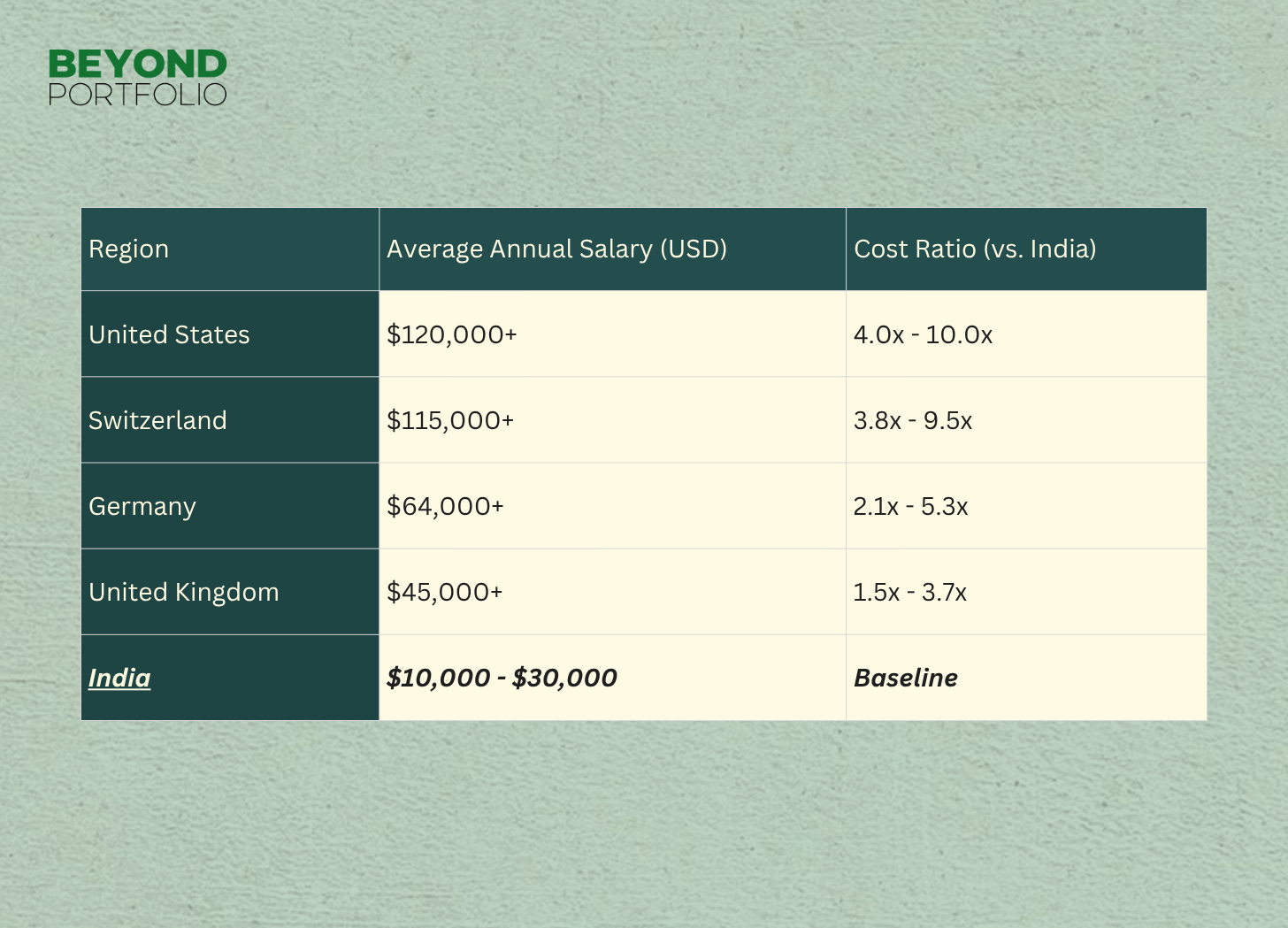
An Indian engineer costs 1/10th of an American engineer. That gap: stark, persistent, and scalable became India’s entire business model. TCS, Infosys, Wipro didn’t build the next Google. They built something arguably more commercially efficient: a machine that executed other people’s ideas, cheaper and faster than anyone else could.
The pyramid was elegant. A few senior architects at the top. An army of junior engineers at the base coding, testing, maintaining at a fraction of what the same work would cost in California. Since the 2010s, almost 50% of Indian developers were working on salaries of less than $10,000. A similarly skilled junior software engineer in the US would cost between $40,000-$80,000 depending on their specialization and education background and this allowed Indian IT firms to sustain operating margins of 26-34% for decades. It wasn’t innovation. It was industrial precision applied to someone else’s vision.
And for a long time, that was enough. But unfortunately, not anymore.
Fun with Numbers: Comparative IT Salaries (2018-2024 Context)
Then AI Walked In. And It Changed Everything.
Four years ago, ChatGPT launched and quietly began dismantling the foundation.
The pyramid- that beautiful, margin-generating pyramid was built on junior engineers doing repeatable tasks. Testing. Bug fixing. Documentation. Maintenance. These are precisely the tasks that AI now does faster, cheaper, and without visa requirements. The numbers are stark.
Mass hiring of fresh engineers has dropped by nearly 75% in two years.
India’s top five IT companies lost over $150 billion in market value in 2025 alone as investors began pricing in the obsolescence of the old model.
Clients are demanding price cuts of up to 20%.
The FII was right. India’s core competitive advantage i.e., skilled, cheap, white-collar labour is exactly what AI undercuts. And here is the part that should bother us most: we still have no Nvidia. No OpenAI. No Amthropic. No foundation model that the world uses. No chip ecosystem. No AI research lab that is setting the agenda globally. We gave the world its best engineers. We watched them build these companies abroad. And now those same companies are building the tools that may replace the model we built.
For a moment, sit with that. Feels like a betrayal? Maybe Yes, Maybe Not. We are asking the wrong questions all this while. The conversation around India and AI has been fixated on the wrong race. Can India build the next Nvidia? Probably not, not in this decade. Nvidia required 30 years of patient, speculative capital, a chip ecosystem that took generations to build, and a research culture that India structurally never invested in.
But that is not the question that matters for investors, or for India’s next chapter. The right question is this: when AI scales globally, who benefits? And the answer to that question looks nothing like the question about Nvidia.
But First, how Does AI Actually Work?

Most people use AI every day without understanding what it costs to run it.
When you type a question into ChatGPT, something happens before the answer appears. Your query travels to a data centre, a warehouse-sized facility filled with thousands of specialised chips called GPUs. Those GPUs process your request at enormous speed, drawing anywhere between 20 to 100 megawatts of power just to keep the lights on. The response comes back in seconds. The infrastructure behind it has been running continuously, at massive cost, for years.
This is the AI value chain that nobody talks about:
The Model → built by OpenAI, Google, Anthropic. Requires years of research, billions in funding, and cutting-edge chip access. This is the layer India doesn’t have.
The Chips → designed by Nvidia, AMD, Intel. Fabricated by TSMC in Taiwan. Decades of investment, impossible to replicate quickly. This is the layer India is beginning to build but is years away from competing in.
The Compute Infrastructure → the data centres that house those chips. Requires land, power, cooling systems, fibre connectivity, and engineering at scale. This is the layer that needs to be built everywhere AI is consumed. And this is where India comes in because consumption is exploding in India.
The Power Grid → data centres are among the most power-hungry facilities ever built. A single large data centre consumes as much electricity as a small city. Someone has to generate that power, build the transmission lines, and keep it running 24/7.
The Connectivity Layer → fibre optic cables, undersea cable landing stations, network infrastructure. Every query, every model call, every API request travels through physical cable. Someone lays it. Someone owns it.
The Enterprise Integration Layer → once AI models exist, businesses need help deploying them. Customising them. Training them on proprietary data. Maintaining them. This is where Indian IT’s existing capabilities find a new role — not as cheap labour, but as AI integration specialists.
Now look at that chain again.
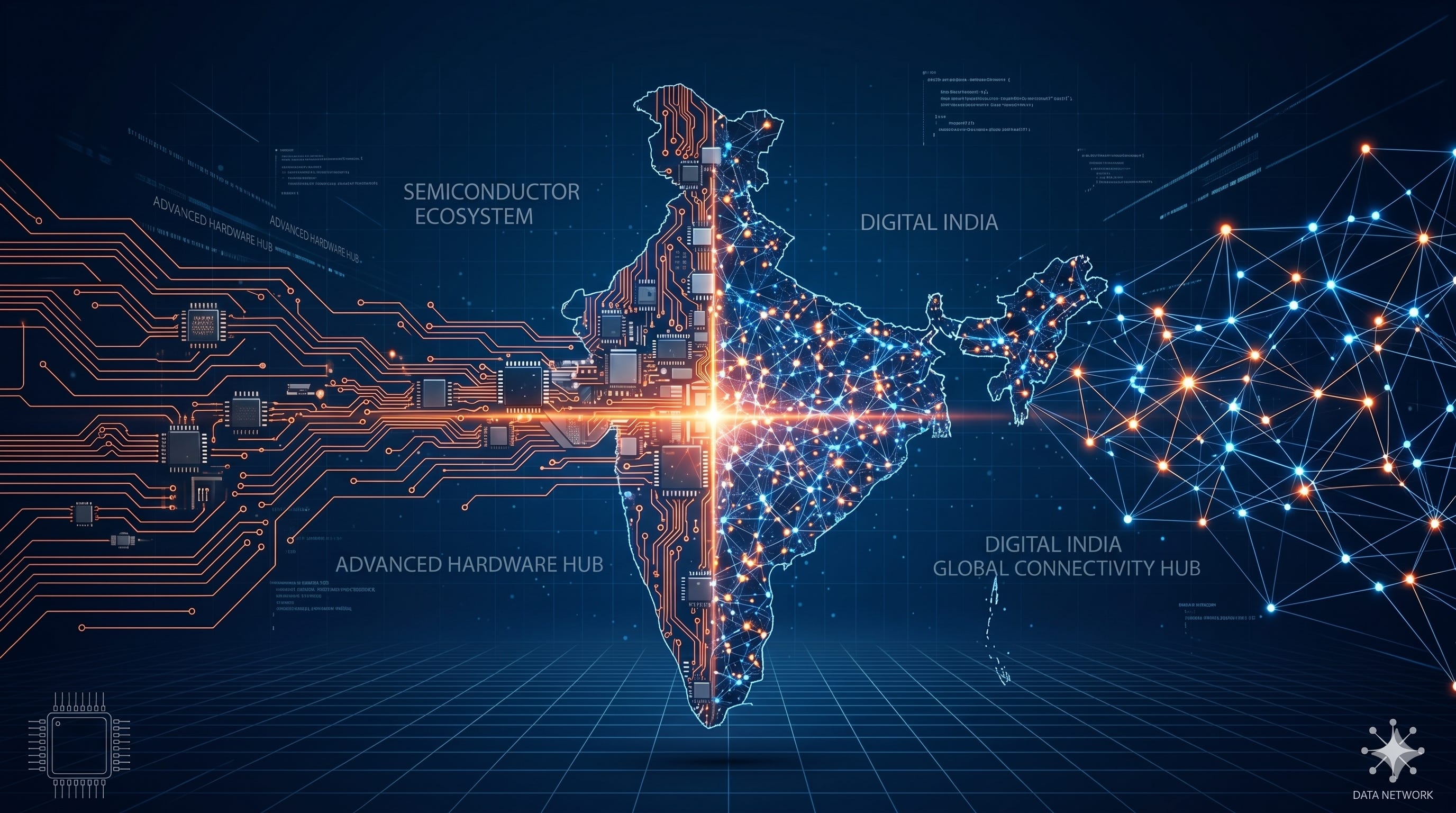
India cannot compete at layers one and two today. Not meaningfully, not yet. But layers three, four, five, and six? That is where ₹27 lakh crore is already being committed. That is where Adani, Ambani, and a dozen infrastructure conglomerates are racing to build. That is where the government’s ₹76,000 crore India Semiconductor Mission is laying the foundation. That is where India’s existing engineering talent finds a second act, not running someone else’s code, but building the physical and digital backbone that every AI model in the world will eventually run on.
India isn’t the GPU. India is literally the grid. Think of it this way. During the California gold rush in the 1840s, the people who got rich weren’t always the miners. They were the ones selling shovels, denim, and food to the miners. The miners were famous. The shovel makers were wealthy. India is not going to be the gold. India is building the mine.
The data centres. The power infrastructure. The fibre networks. The semiconductor packaging. The enterprise software integrations. Every AI model running anywhere in the world will eventually need to run on or run through infrastructure that Indian companies are now positioned to build and own. It is a structurally more durable position- lower speculation risk, tangible assets, government tailwind, and a domestic demand curve that is only beginning.
The Investor Problem: How do you invest in the mine now?
Here is where it gets interesting and slightly complicated. These companies don’t announce themselves as AI stocks. They are listed as power companies. Infrastructure firms. Cable and fibre businesses. Data centre operators. Engineering conglomerates. Finding the ones that are genuinely positioned at the centre of India’s AI infrastructure buildout rather than on its periphery requires knowing exactly where to look.
That’s the research problem we’ve been working on.
We built the Bharat AI Tracker to map exactly this. Not the hype stocks. Not the companies that added “AI” to their investor presentations. The backbone of the companies building the physical and digital infrastructure that India’s AI decade will run on.
If the thesis in this newsletter makes sense to you, that’s where we’ve put it to work: Bharat Tech Infra Tracker
The Larger Point
India didn’t lose the AI race. It was never running the race that Silicon Valley designed. The IT services model is being disrupted, that is real, and the industry will be smaller and different in ten years. But the infrastructure opportunity that AI has created for India is arguably larger, more tangible, and more investable than anything the services era produced. The FII pulling out money sees India as a country without breakthrough technology. They may be looking at the wrong thing. The grid doesn’t make headlines. But it never goes out of business.