
Gold, Made in a Lab? Hard Truths Behind “Synthetic Gold” Claim
Scientists have recently created gold through atomic-level manipulation, which could challenge gold’s status as a safe-haven asset, like how lab-grown diamonds disrupted natural ones.

Gold has always been associated with one value: Scarcity. Central Banks hold it, Households hold it, ETFs track it and jewellers sell it, because no one can make more of it cheaply. A Silicon Valley Startup has made an announcement that disrupts this status.
How was this achieved?
Marathon Fusion, an American company, has succeeded in creating gold artificially by converting mercury isotopes into gold using highly advanced nuclear fusion technology. This technology depends on fusion reactors and immense amounts of energy, and has meant that lab grown gold remains possible in theory.
Marathon Fusion was founded by Adam Rutkowski, a former SpaceX propulsion engineer, in 2023. The company claims that this technology could lead to the production of almost 2 to 5 metric tons, using a 1 gigawatt fusion plant, as per the company’s arXiv’s research paper.
The paper has been posted to arXiv, a preprint server, and has not yet been peer-reviewed by independent scientists.
Separately, Chinese researchers have announced the creation of what they call ‘hard pure gold,’ a 24-carat gold engineered at the atomic level to be significantly harder than conventional gold. Unlike Marathon Fusion’s nuclear transmutation approach, this is a materials innovation, not a supply creation story. The gold is still real Au (atomic number 79), but its crystalline structure has been modified to alter its physical properties. No methodology or independent verification has been published, and this does not represent new gold supply entering the market.
Could this become a gamechanger?
It could, only if the experiments can actually lead to commercial reality. Currently, this remains a conceptual design based on unproven technology, complex materials engineering and unresolved questions on engineering feasibility and viability.
Besides, the claim is yet to be peer reviewed, and as per Marathon Fusion’s own research paper, the gold produced would be radioactive, requiring at least 17.7 years to be safe for commercial use.
If Marathon Fusion can address these challenges (which remain formidable and unresolved) it could disrupt gold’s current status as the timeless asset class that every Central Bank, Domestic Investor, Jeweller and household seeks to own.This would also make the centuries old dream of converting base metals into gold into reality, recalling centuries-old Indian alchemical traditions, including Nagarjuna’s documented experiments with mercury transmutation.
The increased interest in this development remains understandable, as the demand for gold continues to rise, even as gold mining remains increasingly challenging as ore qualities deteriorate, yielding just 1–5 grams of gold per tonne of ore. According to various estimates, almost 86% of the total gold available in the world has already been mined, most above-ground gold now circulating in secondary markets.
In the near term, the scarcity of mined gold means that recycled gold, mostly from old jewellery (almost 90%) and e-waste remains a viable alternative to mined gold. So far, recycled gold has been a viable source of supply for the market, and will continue to remain so in the foreseeable future, until this disruption can actually make an impact in the sector.
Could this go the Lab Grown Diamond Way?
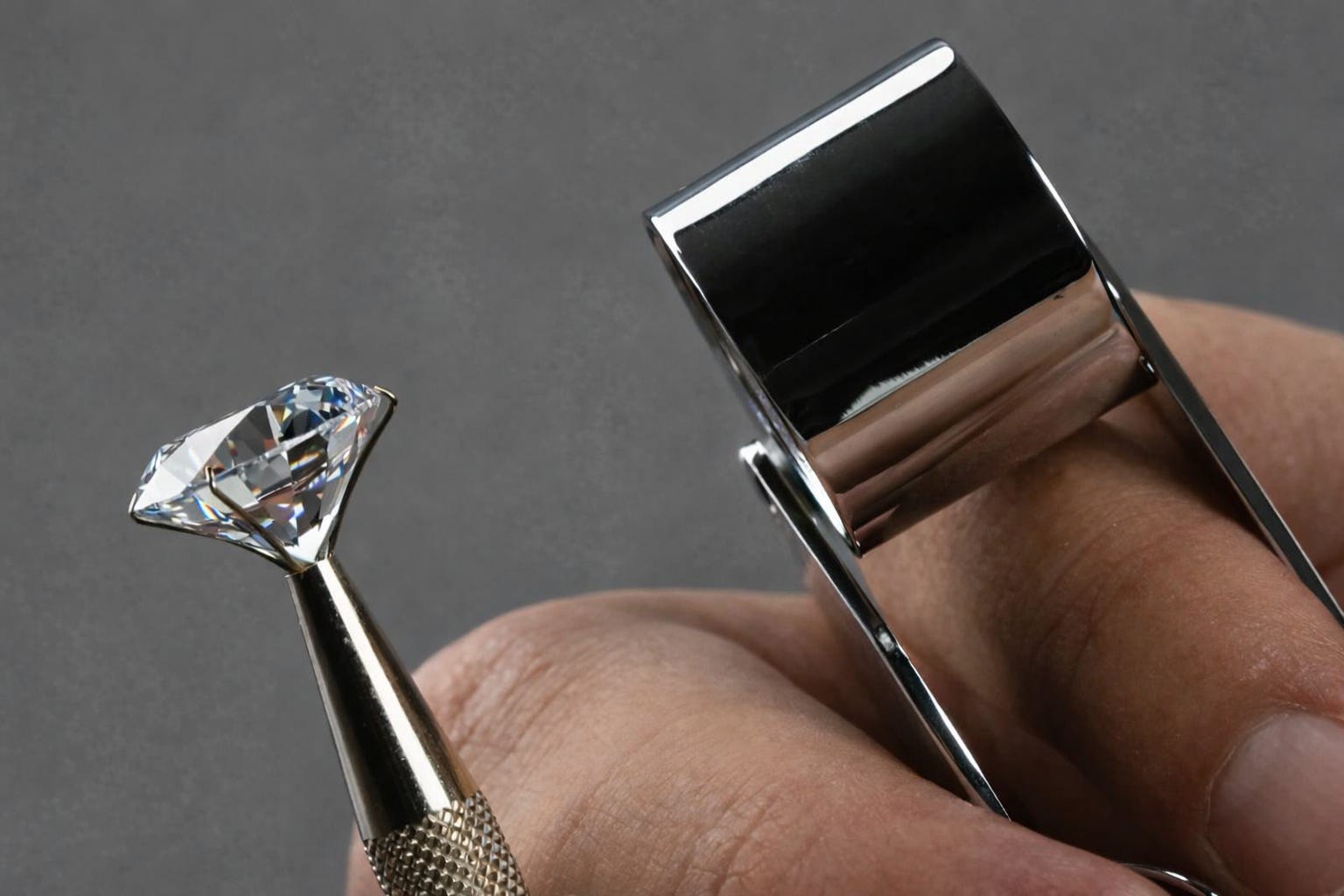
Many in India are drawing parallels to the way Lab Grown Diamonds(LGDs) are slowly replacing mined diamonds worldwide. These manufactured diamonds, which commanded just 5% of the total diamond jewellery market in 2018, will reach almost 20-25% by the end of 2026, as these diamonds are almost 80% cheaper than mined diamonds.
The diamond processing industry clustered around Surat initially scoffed at the idea of using LGDs, but have been forced to manufacture them themselves as the demand for LGDs has replaced that of mined diamonds over the past decade.
Though imitation diamonds had existed long before mined diamonds became commercially available, LGDs offered customers a reason to buy cheaper diamonds even as most didn’t care that they were manufactured not mined.
Diamonds remain a consumer product, with their values remaining largely cultural and emotional. If Lab grown gold could go the same way as Lab grown diamonds, this could fundamentally alter gold’s status as the world’’s most reliable monetary asset. Central Banks that hold 35,000+ tonnes of the yellow metal, would be forced to rethink their holdings, if the intrinsic value of gold plummets due to an increase in supply. This would threaten the economics behind investments, with gold’s scarcity-driven appreciation under threat for the first time in history.
The gap this aims to address

Currently, the gold supply, is limited to about 3,500 tonnes of mined gold every year. Recycled gold adds another 1,200 tonnes, totalling about 4,700 tonnes of annual supply. Marathon Fusion’s simulations project between 2 and 5 metric tons of gold per gigawatt of thermal power per year, depending on reactor configuration.
But this claim remains just that-a claim. As there are no commercially operational reactors that can be used to manufacture gold on an industrial scale. Additionally, according to Marathon Fusion’s own research paper, the gold produced will need 17.7 years to become commercially usable, as the gold produced will be radioactive.
And even if Marathon Fusion’s most optimistic projections hold, 5 metric tons of additional supply represents less than 0.1% of annual gold supply. That does not move markets.
There is also no clarity yet on the cost per gram of lab-produced gold, making commercial comparisons with mined gold impossible at this stage.
For now, this remains just an announcement, as further details will be needed to quantify this as a disruption to the old ways.
Should investors be worried?
For the near term? No commercial threat. At least for the next 5 years, production will remain at atom-scale quantities,as there’s no working reactor that could hypothetically produce gold. Add to that the cooling time of 17.7 years, gold’s scarcity remains intact so far.
For the medium term (between 5-15 years), further clarity on cost per gram data, working reactor milestones and regulatory responses from the Central Banks or the World Gold Council could make an impact before supplies actually make it to the market.
For the long term (15+ years), the scale of the supplies based on the fusion reactor capacity and cooling timelines could affect the financial markets, fundamentally altering gold’s role in global financial markets. That is if supplies actually affect gold’s scarcity factor.
For now, Lab-grown gold is real science. It is not yet a real supply. The 17.7-year cooling time, the missing commercial reactor, and the enormous gap between 2 metric tons of simulated output and 3,500 tonnes of annual mining demand make near-term disruption unlikely. What it does change, perhaps sooner than the technology itself, is the conversation around gold’s scarcity premium. And in markets, narratives often move faster than fundamentals.